Bedding guide
The Clean Bedroom Down Comforters: Choosing a Weight for Each Season
A comforter’s warmth is not simply a matter of how lofty it looks. The right choice depends on the temperature of your room, the way your body responds to heat, and the layers already on your bed. Understanding the difference between summer, year-round, and winter weights can help you build a sleep setup that feels comfortable across changing seasons.
A small climate of your own
Each night, the space beneath a comforter becomes a small, shifting climate. Your body gives off heat; bedding slows its movement into the room. A bedroom’s temperature, airflow, humidity, pajamas, sheets, mattress, and other covers all influence how warm that enclosed space becomes. Even two people sharing the same bed may experience it differently: one may pull the covers close while the other turns them back.
That is why choosing among down comforter weights is less like picking a season on a calendar and more like balancing a system. A warm bedroom can make a winter-weight comforter feel excessive. A cool room, light sleepwear, and a tendency to feel cold may make a summer option feel too spare. The label describes a starting point, not a guarantee of how every sleeper will feel.
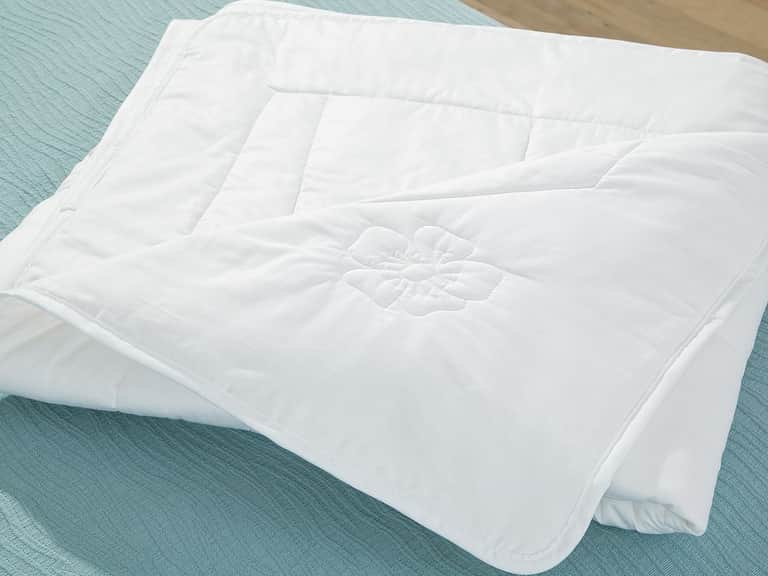
The Clean Bedroom’s Manhattan Goose Down Comforter is offered in summer, year-round, and winter weights. Each version uses 95% large-cluster Hungarian white goose down with an 850 fill power and a soft TENCEL™ lyocell shell. The different weights vary in down fill and construction, giving sleepers a way to choose a lighter or more insulating layer while retaining the same general material approach.
What “weight” means in a down comforter
In bedding, weight can refer to more than one measurement. A comforter’s overall physical weight includes its fabric shell, stitching, and filling. Fill weight refers specifically to the amount of down inside it. Warmth is related to filling and construction, but it is not determined by a single number in isolation.
Down is the soft, three-dimensional cluster beneath a bird’s outer feathers. Its branching structure can hold pockets of air, and still air acts as insulation. The amount of down, its quality, the way it is distributed, and the comforter’s compartments all affect how the bed retains warmth. Fill power describes the lofting capacity of down under a standardized measurement; it is not a warmth rating by itself. An 850 fill power down can create substantial loft with relatively little weight, but the comforter’s warmth still depends on how much down is used and how the product is constructed.
In a comforter specification, ounces of fill are therefore useful for comparing sizes or versions within a particular range. They should not be read as the total weight of the finished comforter, nor as a universal warmth scale that can be directly compared across every brand. Different designs, shell fabrics, baffle arrangements, and testing conventions can make simple comparisons misleading.
For The Clean Bedroom Manhattan model, the listed fill amounts make the seasonal distinctions clear. The winter version carries the most down, the year-round version sits between the extremes, and the summer version uses the lightest fill. This gives shoppers concrete information to consider alongside their own room conditions and sleep preferences.
Three weights, three starting points
The names “summer,” “year-round,” and “winter” offer a helpful shorthand. They are not strict climate boundaries. A summer-weight comforter may suit a warm sleeper through much of the year in a heated home; a winter-weight version may be welcome in a drafty room long after the calendar turns to spring. Think of the labels as describing relative insulation, then adjust for your own environment.
Summer weight: less insulation, more room to breathe
A summer-weight comforter is the lightest option in the Manhattan down range. Its listed fill amounts are 18 ounces for Twin, 23 ounces for Queen, and 28 ounces for King. The construction is described as sewn-through, with an 8-inch design. That lighter fill can be a sensible starting point for a warm bedroom, a person who often feels hot at night, or a bed that already has additional layers.
Choosing a lighter down comforter does not mean abandoning the comfort of a cover. It means using a less insulating layer as the main top covering. In mild weather, it may be enough on its own. When the room cools, a blanket or other layer can be added as needed, giving the sleeper more flexibility than beginning with a very warm comforter and trying to cool the bed afterward.
Consider how the room behaves overnight, not just at bedtime. A sun-warmed apartment may cool substantially after midnight; a well-heated room may stay steady. If you are unsure, notice whether you regularly kick off your current covers, wake feeling too warm, or sleep comfortably with only a light blanket. Those patterns are often more useful than the season printed on the calendar.
Year-round weight: a middle ground
The year-round version is the middle option in this range, with listed fill amounts of 26 ounces for Twin, 37 ounces for Queen, and 45 ounces for King. It uses a 10-inch baffle-box construction. For many sleepers, a middle-weight comforter can provide useful warmth without requiring a complete bedding change every time the weather shifts.
“Year-round” should not be taken to mean ideal for every room, climate, or person in every month. It is a practical description of a moderate warmth level. A sleeper in a temperate home with stable indoor heating may find it comfortable across much of the year. Someone in a humid climate or a consistently warm apartment may still prefer a lighter option; someone in a cold room may want more insulation.
Layering can make a year-round comforter adaptable. Use it with breathable sheets and minimal extra covers when the room is mild. Add a blanket when the temperature drops, or remove one when the nights warm up. The best arrangement is the one that lets you adjust without turning the bed into a stack of heavy textiles.
Winter weight: more fill for colder conditions
The winter version contains the most down in this collection: 32 ounces in Twin, 46 ounces in Queen, and 56 ounces in King. Its 15-inch baffle-box design includes a 2-inch gusset, creating a deeper profile than the lighter versions. The larger fill amount is intended to provide more insulation, a quality that can be useful in colder bedrooms or for sleepers who tend to feel chilled.
A winter-weight comforter may be a poor match for a warm room, however, even if the outdoor weather is cold. Central heating, a warm mattress, several blankets, and a naturally warm sleep pattern can all contribute to overheating. Conversely, a cold room may call for more warmth even in a season commonly associated with mild nights. Room temperature and personal comfort should guide the decision more than the month.
Before choosing the heaviest option, consider whether you can adjust the room or remove other layers. Sometimes the solution is a lighter sheet, fewer blankets, or a change in sleepwear rather than a heavier comforter. The aim is balanced warmth, not maximum loft.
Read the room—and your own sleep
Start with a few ordinary observations. Is the bedroom cool at dawn? Does the heating run overnight? Do you wake up warm, cold, or comfortable? Do you share the bed with someone who prefers a different temperature? These details can make a nominally “year-round” comforter feel entirely different from one household to another.
- If you tend to feel warm: Consider a summer-weight comforter, especially if your bedroom stays warm or you use several layers.
- If you feel comfortable in a range of conditions: A year-round weight may offer a useful middle ground, with a separate blanket available for colder nights.
- If you tend to feel cold: A winter-weight comforter may provide additional insulation, particularly in a cool room.
- If partners disagree about warmth: Separate blankets or different top layers on each side of the bed may be more comfortable than trying to satisfy both sleepers with one weight.
- If your room changes sharply by season: Choose for the conditions you experience most often, then use removable layers to adapt.
These are starting points, not medical or climate rules. Sleep comfort is individual. A person’s perception of warmth may also change with sleepwear, activity, bedding materials, and room airflow. If you are replacing a comforter that has been uncomfortable, take note of what went wrong: Was it too warm throughout the night, or only at the start? Did it feel heavy, or simply trap too much heat? The distinction can help you make a more precise choice.
Sheets matter because they sit directly against the body and can alter the first impression of the bed. Cotton percale often feels crisp and cool to the touch, while sateen tends to feel smoother and more substantial. Linen has a distinctive texture and is often valued for airflow and moisture management. These fabric characteristics do not replace the comforter’s insulation, but they contribute to the whole sleep environment.
The role of construction and materials
Down needs to be held in place so it remains distributed across the comforter instead of collecting in one area. Stitching and compartment design help create that structure. The Manhattan comforter’s summer option is sewn-through, while its year-round and winter versions use baffle-box construction. These designs are not merely decorative: they help shape the comforter and manage the distribution of the filling.
The winter model’s 2-inch gusset gives its edge additional depth. A deeper construction can create a fuller profile, but loft should not be confused with the exact warmth a person will experience. Warmth still depends on the amount and quality of the down, the room, the sleeper, and the other bedding layers.
The outer shell is made from TENCEL™ lyocell, a fiber produced from wood-pulp cellulose. In this comforter, the shell is described as a soft sateen finish. The shell is the surface that contains the down and touches the duvet cover; its feel and construction are part of the overall bedding experience. The comforter is filled with 95% large-cluster Hungarian white goose down, and the product information lists an 850 fill power.
For readers comparing options, the The Clean Bedroom Manhattan Goose Down Comforter is a direct example of a range that offers all three weights. Its listed dimensions are 68 by 86 inches for Twin and 90 by 94 inches for Queen; the King is 108 by 94 inches. Confirm current sizing and construction details against the product information before ordering, particularly if you are matching an existing duvet cover or mattress setup.
Plan the layers around the comforter
A bed works as a set of interacting layers. The fitted sheet protects the mattress and provides the base surface. A flat sheet, if used, sits between the sleeper and the comforter. The comforter contributes insulation; blankets, quilts, or coverlets add further warmth and texture. The duvet cover, when used, protects the comforter and can be removed for laundering, but it does not change the comforter’s fill weight.
In a warm room, keep the combination simple: a breathable sheet and a lighter comforter may be enough. In a room that cools at night, a medium-weight comforter paired with an easily removable blanket can offer more control. In a cold bedroom, a winter-weight comforter may be joined by a layer that can be folded back or removed as needed. Avoid assuming that more layers always mean better comfort; trapped heat can build when the room and bedding are already warm.
Pay attention to how the comforter sits on the bed, too. A duvet cover that is too small can compress the filling; one that is much too large can allow it to shift. Corner ties or other attachment points, when provided, help keep a comforter from sliding inside the cover. The Manhattan comforter description lists double-stitched piping and, for the winter version, a gusseted construction. Check the specific details for the chosen size and weight rather than assuming every version has identical features.
Care is part of choosing well
A comforter is a substantial household textile, and its care requirements should be part of the decision. The Manhattan down comforter’s listed instructions are to dry clean. Always follow the care label supplied with the particular item; do not assume that a washable duvet cover means the comforter itself can be machine washed. A cover can be laundered more routinely, helping protect the inner comforter from everyday contact.
Between cleanings, regular airing and careful handling can help keep bedding fresh. Use a duvet cover if the comforter is designed to fit one, and avoid pulling or shaking aggressively at seams. Store a comforter clean and completely dry in a breathable storage bag or well-ventilated space, rather than compressing it tightly for long periods. Persistent moisture can damage textiles and create conditions where odors develop.
Check the care instructions before purchase if professional cleaning is inconvenient or if you need bedding that can be laundered at home. This practical consideration may matter as much as the distinction between summer and winter warmth. A comfortable weight should suit not only your sleep habits, but also the way you can reasonably maintain it.
A simple decision process
To narrow the choice, begin with your normal bedroom conditions. If possible, note the temperature range at night over several days, including the early morning hours when a room may be coolest. Next, assess your own pattern: Do you often uncover yourself, or reach for an extra blanket? Then list the layers you already use and consider whether they are likely to remain in place through the season.
- Describe the room: Is it usually warm, moderate, or cool overnight? Does heating or air conditioning change the temperature?
- Describe the sleeper: Do you usually feel warm, neutral, or cold under your current bedding?
- Count the layers: Include sheets, blankets, quilts, sleepwear, and any mattress topper that may affect heat retention.
- Choose a starting weight: Consider summer for lighter insulation, year-round for a middle option, and winter for more fill in colder conditions.
- Check practical details: Confirm size, construction, shell and fill information, and care requirements.
If the choice remains uncertain, a moderate option with a separate removable layer can be easier to adjust than an especially heavy comforter. If you know your room is consistently warm and you sleep hot, however, selecting a lighter weight may prevent the need to manage excess heat every night. The most useful decision is grounded in the conditions you actually experience.
A final measure of comfort
Down comforters turn small air spaces into a layer of insulation, but the experience of warmth emerges from more than the filling. Room temperature, sleep habits, sheets, construction, and care all influence the result. The Clean Bedroom’s summer, year-round, and winter options offer three distinct starting points: 18 to 28 ounces of fill for summer, 26 to 45 ounces for year-round, and 32 to 56 ounces for winter, depending on size.
Use those figures to understand how the range is differentiated, then look beyond the numbers. A light comforter in a warm room may be more restful than a lofty one. A fuller comforter can make a cool bedroom feel inviting, but it may be unnecessary when heating and extra layers already provide warmth. There is no universal weight for a season; there is the weight that works for the particular room and sleeper.
When you compare down comforter weights, let your own nights be the guide. The right choice should feel comfortable across the hours you sleep, work with the layers you use, and remain practical to care for. In a bedroom’s quiet climate, small adjustments can make the difference between constantly shifting the covers and settling in for the night.